

Anyone who has run a large channel incentive program in India knows that the festive season does not start in December. It starts in late September with Onam, builds through Dussehra and Diwali, and only really winds down in the new year. For most sales teams, that stretch is the most important four months of the year. Targets are stretched, dealer schemes are rolled out, and large pools of incentive money are committed against a single window of opportunity.
By the time February arrives, finance is still reconciling payouts from a campaign that ended weeks ago. Sales has moved on to the next quarter. And no one can quite tell you which region the program actually worked in, or whether the money spent translated into the kind of behaviour it was meant to encourage.
Why Cash Payouts Become Difficult To Track At Scale
The reason this happens is not that cash payouts fail to reach dealers. The reason is that a cash transfer, once it leaves the company’s account, stops carrying any information about why it was sent. It arrives in the dealer’s account looking like every other credit that month — no campaign name attached, no target it can be traced back to.
For finance teams, this means reconciliation becomes a manual exercise of matching scheme records against payout files across thousands of dealers. For sales heads, post-campaign analysis becomes guesswork. And for the dealer, the money is real, but the recognition behind it fades quickly into the noise of monthly cash flow.
Beyond a certain scale, cash payouts deliver the value but lose the meaning.
Cash Payouts Vs Voucher Rewards: What Motivates Channel Partners Better?
There is a finding from research on incentive program that tends to surprise sales heads. When two groups of channel partners are run through the same campaign, one rewarded in cash and one with non-cash equivalents of the same value, the non-cash group consistently delivers stronger performance. What makes it stranger is that when participants are asked afterwards which they would have preferred, the majority say cash.
Why Dealers Say They Prefer Cash Rewards?
This cuts against what most sales leaders are told by their own dealers. Dealers, almost without exception, say they want cash. They are not wrong to say so — cash is liquid, it solves immediate problems, and in a trade where margins are tight, it genuinely helps. The finding is that what people want and what motivates them to perform are not always the same thing.
Why Non-Cash Rewards Can Keep Campaign Recall Alive?
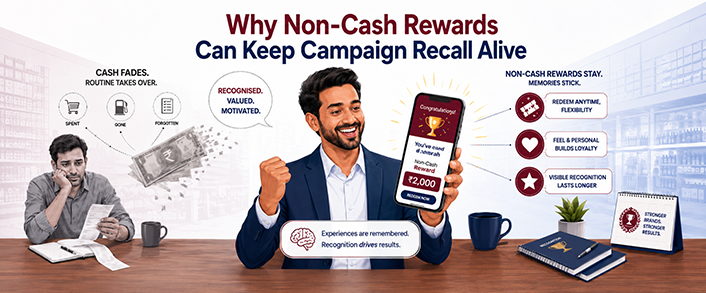
The mechanism is straightforward once it is named. A cash reward gets categorised by the recipient alongside salary and working capital — functional money, spent quickly and without ceremony. A non-cash reward of the same value gets categorised differently. It is set apart in the recipient’s mind as something they earned for a specific reason, and that mental separation is what allows it to keep working as a motivator long after it has been paid out.
What Has Changed In Channel Incentive Program Management In India?
Two things have shifted in the last few years that make this gap harder to ignore.

Section 194R And The Tax View On Channel Incentives
The first is regulatory. In 2022, the Income Tax Act introduced Section 194R, which brought benefits and perquisites given by businesses to their channel partners under the ambit of TDS — whether in cash or in kind, once the value crosses twenty thousand rupees per recipient in a financial year. The tax position between cash and non-cash incentives has been largely flattened. For years, one of the unstated arguments in favour of cash was that it was the cleaner option from a tax standpoint. That argument no longer carries the weight it once did.
Why One-Size-Fits-All Dealer Rewards Feel Less Relevant Today
The second shift is to do with how dealers themselves have changed. A dealer in Indore and a dealer in Kochi may be running comparable businesses on paper, but what works as a reward for one will often do very little for the other. Demographics have widened, aspirations have widened with them, and a one-size-fits-all incentive structure now tends to feel generic. The reward that genuinely moves behaviour is the one that feels relevant to the specific person receiving it, and that relevance is increasingly difficult to engineer with cash alone.
Cash is no longer the default that requires no defence. It is one of several choices, and like all choices in a well-run program, it deserves to be examined on its merits.
Cash Or Vouchers: Which Is Easier To Manage For Sales Teams?
The honest position is not that cash is wrong, or that non-cash is universally better. Both have a place, and the right mix will look different for an FMCG company than for a building materials brand or a financial services firm. What has changed is that the conversation can no longer rest on the assumption that cash is the natural default and everything else is an experiment.
Designing Incentive Program That Build Behaviour, Not Just Transactions

For a sales head designing the next campaign, the more useful question is probably not cash or vouchers. It is whether the program, as currently designed, is doing any work after the payout has cleared. If the data trail goes cold the moment the transfer is complete, the program is settling a transaction rather than building a behaviour.
A note from GyFTR — we work with brands designing and running large channel and dealer incentive program across India. If a conversation on any of this would be useful, we are happy to share what we have seen across our network.